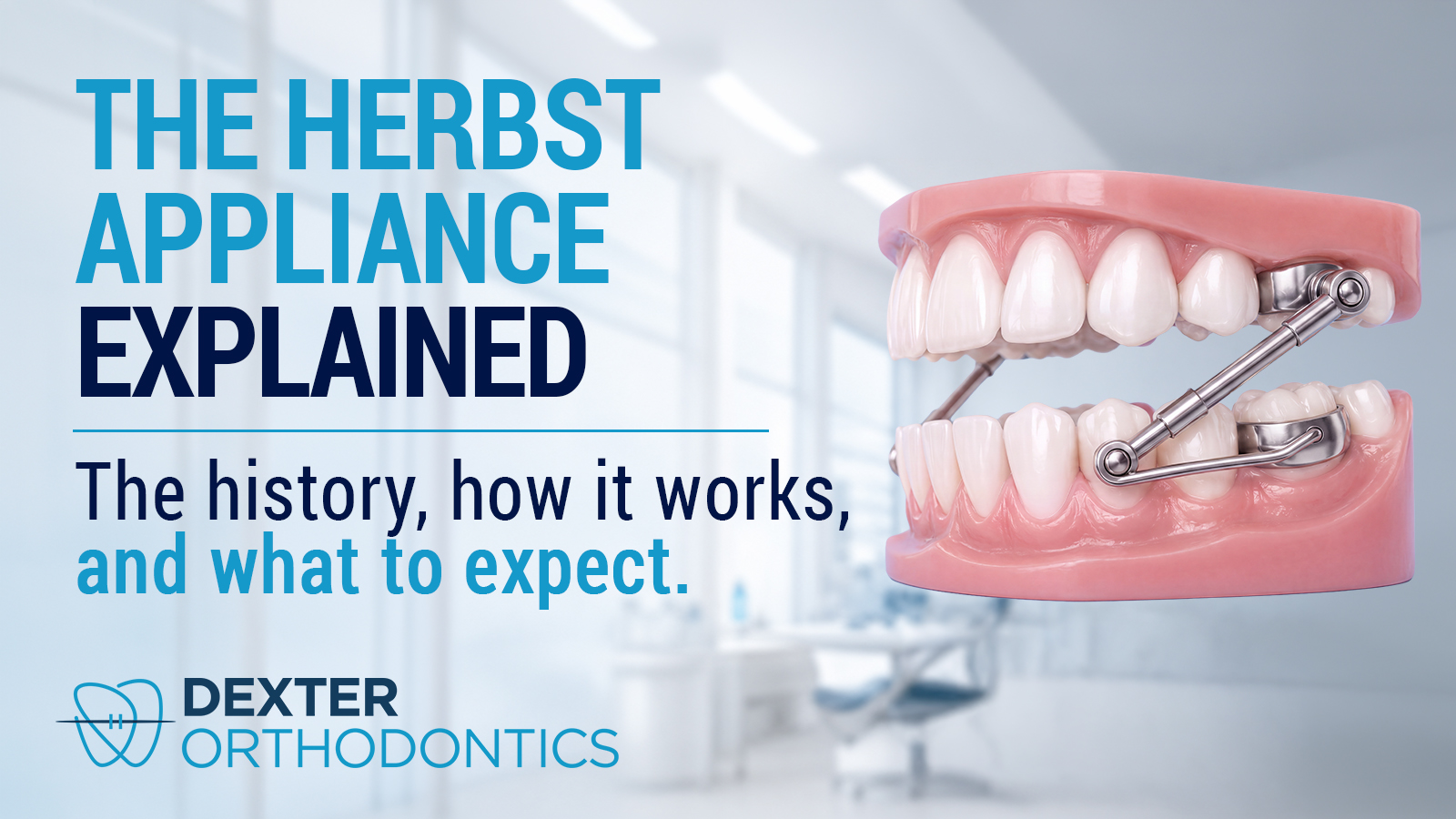
Hearing your orthodontist mention a "Herbst appliance" for the first time can feel like a lot. Unlike a retainer or aligner trays, it's attached to your child's teeth with orthodontic bands and stays there around the clock for months — and for a nervous parent (or an even more nervous kid), that alone can raise plenty of questions before the appointment is even over.
At Dexter Orthodontics, we've found that most of that worry comes down to simply not knowing what the appliance does, how long it's been used, and what results to realistically expect. So let's walk through all of it — the history, the mechanics, the research behind it, and exactly what the first few weeks actually look like.
1.png)
The Herbst appliance isn't new or experimental — it's more than a century old. German orthodontist Dr. Emil Herbst developed it in the early 1900s and presented it at an international dental congress in Berlin in 1909. The original version used silver or gold rod-and-tube hardware anchored with lingual arches, and it saw steady use across Europe for the first half of the century.
Then it largely disappeared from the literature for almost 70 years. It wasn't until the late 1970s that Swedish researcher Dr. Hans Pancherz revived the design at Malmö University in Sweden, this time backed by rigorous, published clinical research — including patients followed for more than 30 years after treatment. That body of research is a big part of why the Herbst remains one of the most widely used, best-documented growth-modification tools in orthodontics today, and why it's not treated as an experimental or fringe option.
Since Pancherz's revival, the appliance has continued to evolve. Anchorage methods have shifted over the decades from bands to bonded crowns to mesh pads, and newer variants like the MiniScope Herbst and PowerScope were developed specifically to make the hardware smaller, more comfortable, and less prone to coming apart than the earlier designs. Interestingly, a modified, removable version of the same rod-and-tube concept has also found a second life in adult sleep apnea treatment — a good sign of just how sound the underlying mechanical idea has proven to be.
.jpg)
The Herbst appliance treats a Class II bite — when the upper teeth and jaw sit too far forward relative to the lower jaw, usually because the lower jaw hasn't grown enough yet. Before appliances like this existed, orthodontists relied on headgear for the same goal, but headgear only works if it's actually worn as directed, and convincing a teenager to wear visible external gear for the recommended hours is its own daily battle.
The Herbst removes compliance from the equation entirely. Orthodontic bands are fitted around the teeth, and the appliance's rod-and-tube mechanism attaches to those bands on each side of the mouth, holding the lower jaw in a more forward position while applying light backward pressure on the upper jaw. Because it's fixed in place this way, it's working 24 hours a day rather than only when a child remembers to put it on. Depending on how much correction is needed, the appliance may be periodically activated during treatment — small adjustments that gradually shift the jaw further into its ideal position as treatment progresses.
One of the most reassuring things about the Herbst appliance is how well-studied it is. Cephalometric research consistently shows the correction comes from a mix of real jaw growth and tooth movement — commonly cited around 60% skeletal change and 40% dental change, with studies measuring average Class II correction of roughly 6mm. In plain terms, this isn't just shifting teeth into a better-looking position; it's genuinely encouraging the lower jaw to grow and catch up.
That's also why timing matters. The appliance works best during a child's active growth years, generally ages 9 to 14, while there's still enough natural jaw growth left to influence. Treating too late, after the major growth spurt has passed, shifts more of the correction toward the dental side and less toward true skeletal change — which is exactly why orthodontists are often watching a child's growth pattern closely to catch the right window.
Every orthodontic appliance involves tradeoffs, and it's worth being upfront about them. The most commonly noted effect in the research is some forward tipping of the lower front teeth as part of the correction process. This is a well-understood, monitored part of treatment rather than a surprise complication, and it's a major reason braces or Invisalign typically follow Herbst treatment — to fine-tune tooth position and keep everything aligned for the long term. Regular monitoring throughout treatment is exactly how we keep an eye on this and adjust as needed.
.png)
Perhaps the most important reason to address a jaw-growth issue early: catching it while a child is still growing gives the appliance something to work with that simply won't be there once growth has finished. Waiting until adulthood often means the only remaining option is Corrective Jaw Surgery — a far more involved process than most families would choose if an earlier option was available. Treating the issue during the growth window is often the difference between guiding the jaw's development and needing to surgically correct it later.
Most patients wear a Herbst appliance for around 9 to 12 months, after which treatment typically continues with braces or Invisalign to complete the alignment. Our Herbst Appliance page covers the day-to-day specifics of care and maintenance. If your child is approaching this stage of treatment, we'd be glad to walk you through exactly what to expect at a complimentary consultation.
The adjustment period is almost always shorter than parents expect. Most kids notice a few days of different-feeling bites, extra saliva, and mild speech changes — reading aloud at home for a few minutes a day speeds that up. Softer foods make the first week easier, and orthodontic wax handles any spots that feel irritated while the cheeks toughen up.
Two common worries we hear — whether the appliance will be visible to classmates, and whether it'll interfere with sports or singing — both tend to resolve quickly. It sits mostly out of sight unless a child laughs or opens wide, and most kids return to their normal activities within the first couple of weeks.
