If you have looked into braces or Invisalign recently, you have probably noticed the word "3D" everywhere: 3D scans, 3D models, 3D printing. It's fair to wonder whether that is real progress or just modern-sounding marketing, and what any of it actually changes for your child or for you.
At Dexter Orthodontics, we see 3D technology as a set of tools that help us measure more precisely, plan more carefully, and explain treatment more clearly. It never replaces an orthodontist's judgment, but it gives that judgment far better information to work with. Here is how it shows up at each stage of care.
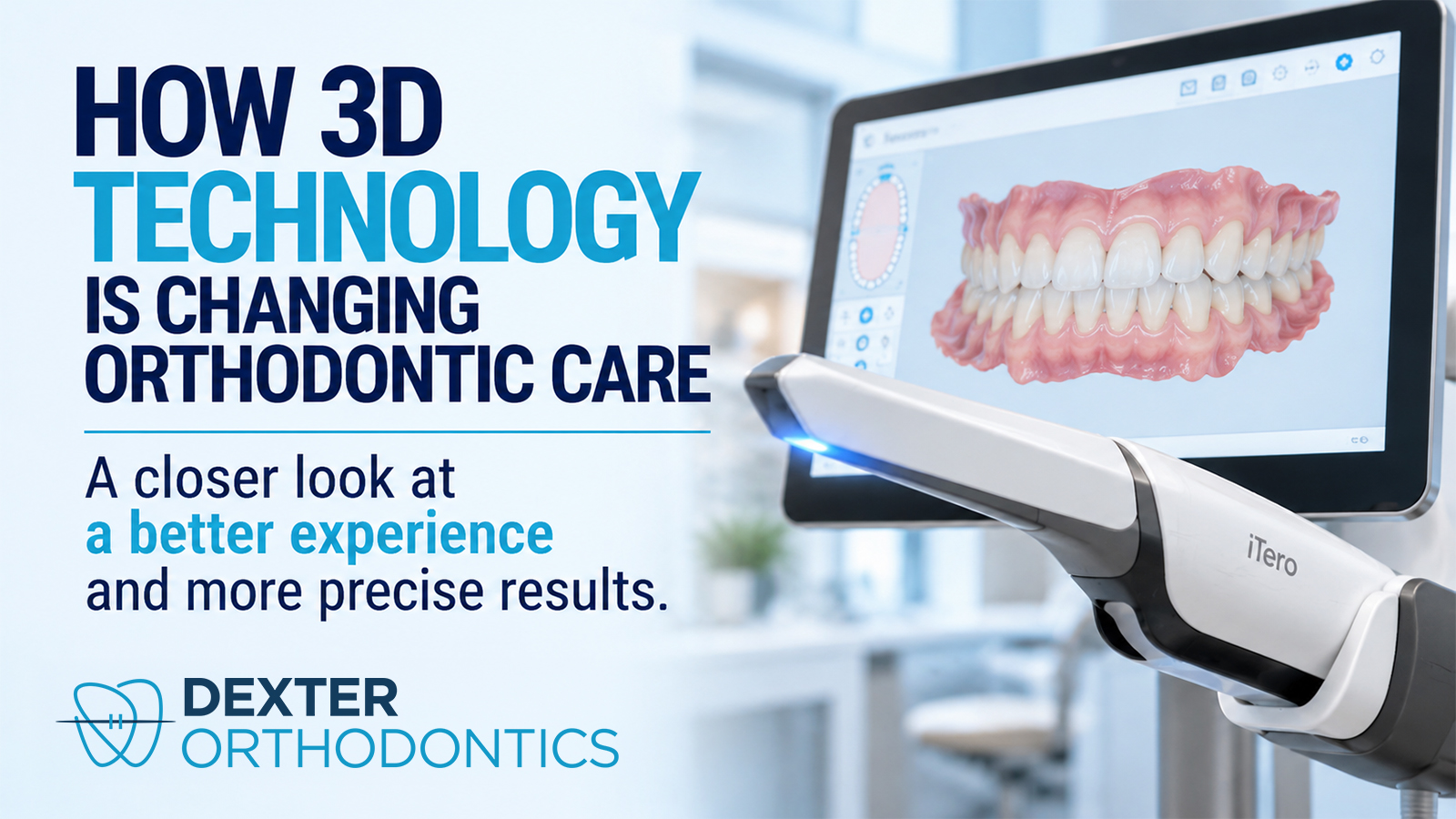
Most modern orthodontic care begins with a digital scan instead of a tray of impression putty. A small wand captures thousands of images of the teeth and gums, and software stitches them into an accurate 3D model of the bite. We cover the scanning visit itself on our 3D Scanning page, but the bigger story is what that model makes possible once it exists.
A digital model can be measured, rotated, and compared over time in ways a plaster mold never could. It becomes the foundation for nearly every other step in treatment.
With a 3D model, an orthodontist can map tooth movement virtually, stage by stage, before a single appliance is placed. For clear aligner treatment, this digital plan is how each aligner in the series gets designed, and it often lets patients see a projected preview of their finished smile at the very start.
That preview is a powerful conversation tool, but it is a plan, not a promise. Teeth are living structures that respond to bone, growth, and how consistently aligners or elastics are worn, so we monitor progress and adjust the plan whenever the teeth tell us something new.
A scan shows what you can see in the mouth. Some cases also call for a look at what you can't see, such as root positions, an impacted canine, or the shape of the jaw. That is where cone beam computed tomography (CBCT), a type of 3D X-ray, can help.
Because CBCT uses more radiation than a standard dental X-ray, it isn't meant for every patient. A review of CBCT use in orthodontics concluded it should be ordered case by case, after a clinical exam, when the added detail clearly outweighs the extra exposure, with impacted teeth among the most common reasons. It can also play a role when planning Corrective Jaw Surgery.
Once a plan is set, 3D printing turns it into physical pieces built for one specific mouth. Most clear aligners are formed over a series of 3D-printed models of the teeth, one for each stage. Printed trays can also carry braces brackets to the teeth so each one lands exactly where the digital plan placed it, a technique called indirect bonding. Retainers are commonly made from printed models as well.
The research backs up that precision. A 2025 systematic review of 3D printing in orthodontics found that printed bonding trays and retainers fit within clinically acceptable limits. Printing aligners directly, with no model in between, is still an emerging approach.
For parents and patients, the benefits of 3D technology are practical ones:
Sometimes it helps, mainly by reducing remakes and refining the plan, but no technology can move teeth faster than healthy bone allows. How long treatment takes still depends on the type of correction needed, your child's growth, and day-to-day cooperation. The real advantage of 3D tools is precision and planning, so each month of treatment does its job well.
If you'd like to learn more, see how Invisalign treatment is planned digitally, or read what to expect after treatment on our Retainers page. When you're ready, schedule a complimentary orthodontic evaluation and we'll walk you through how these tools fit into your own treatment plan.
